
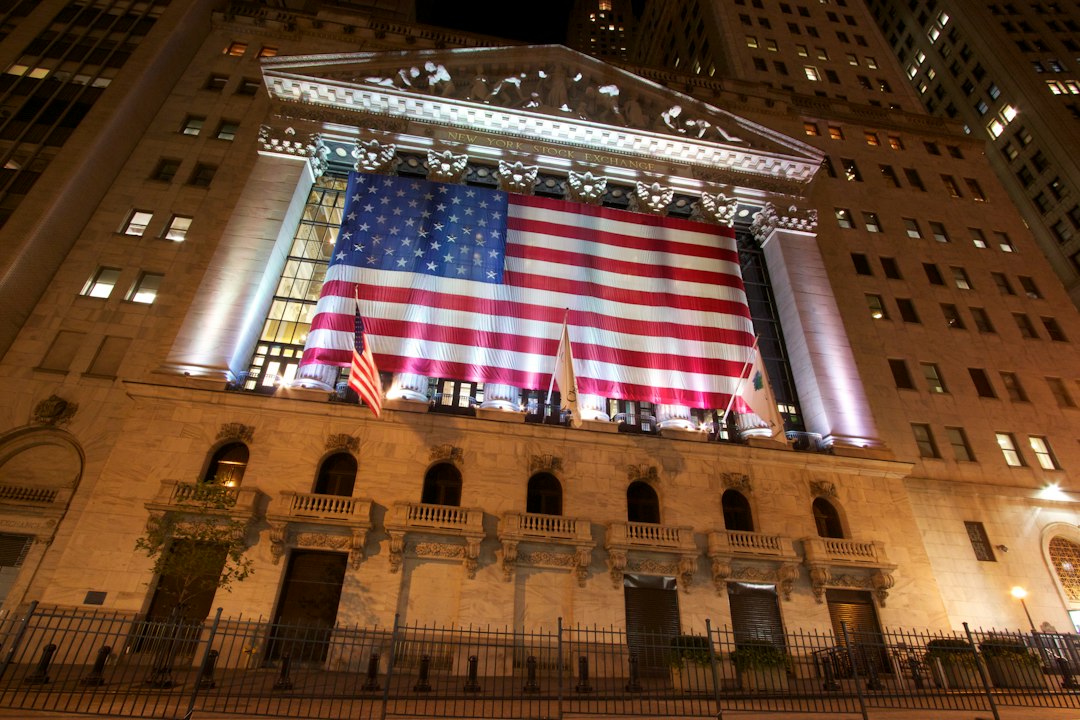
Earnings season is doing what the Federal Reserve cannot right now: steadying the market. With the Fed in its pre-meeting blackout ahead of the 27–28 FOMC session, corporate profit reports stepped into the void on Tuesday, pulling the Dow up more than 500 points while the broader market held its ground — even as AI-related stocks kept investors on edge.
What Happened: A Tale of Two Markets
Tuesday's session split cleanly along a fault line that has defined 2026: old-economy resilience versus new-economy anxiety. The Dow Jones Industrial Average gained 529.85 points, or 1.02%, to close at 52,495.88. The S&P 500 added 21.84 points, finishing at 7,712.57, a gain of 0.28%. The Nasdaq Composite, weighed down by tech and communication services, edged down 6.07 points — less than 0.02% — to 26,424.82.
The engine of Tuesday's gains was unmistakably corporate earnings. 3M surged after reporting third-quarter earnings that beat expectations, raising its full-year outlook and announcing an expanded data-center partnership that grants Amazon warrants for 3.2 million shares after the tech giant spent $6 billion on 3M connectivity products. Hasbro climbed 11.2% after its Magic: The Gathering game posted more than $600 million in revenue during the quarter for the first time. Equifax rallied 11.3% on a stronger-than-expected summer profit despite high mortgage rates. Eli Lilly added on metabolic drug pipeline progress, and UnitedHealth gained roughly 3%.
Nine of the 11 primary S&P 500 sectors closed in the green. Health care led with gains of more than 2%, real estate added, and utilities followed. Airlines caught a tailwind from retreating oil prices: American Airlines gained 3.7% and United Airlines rose 2.3%.
On the losing side, General Motors tumbled nearly 7% despite beating quarterly profit expectations, after issuing a full-year outlook whose midpoint fell short of analyst expectations. GE Aerospace fell. Alphabet and Apple each declined more than 1%. Tesla, however, rose about ahead of its own earnings report.
Why It Matters: Rates, Oil, and the AI Question
Tuesday's session was not just about earnings — it was a referendum on whether the market can hold up under the dual pressure of elevated interest rates and a wobbling AI trade. For one day, the answer was yes, but the margin was narrow.
Treasury yields eased as weak housing data cooled near-term rate-hike expectations. The benchmark 10-year yield slipped below, down about 2 basis points from Monday's close, while the 30-year yield eased toward. Pending home sales plunged month over month in September — the lowest reading since the series began in 2001 and far worse than the decline economists had forecast, according to the National Association of Realtors. That kind of demand destruction is ugly for housing, but it gave bond markets — and equity valuations — a moment to breathe.
Oil added another layer of relief. West Texas Intermediate crude futures fell nearly 2% to settle at $101.79 a barrel, while Brent crude slipped to $108.79. Reports that mediators had presented a proposal to revive peace talks between the U.S. and Iran drove the retreat. Brent had approached $112 earlier in the session — near its highest price since the war with Iran began in late February — before reversing. The yo-yo between $97 and $112 per barrel this month reflects how much uncertainty remains around energy supply, and any sustained move lower would take real pressure off inflation.
"For much of this year, the market has been willing to look through higher rates because the growth story, notably that around AI, was strong enough to justify it. Last week, we saw that relationship begin to be tested."
- Jake Behan, Head of Capital Markets, DirexionBehan's framing cuts to the core of this market's vulnerability. The AI trade that drove so much of 2026's gains now faces a credibility test: can the returns justify the borrowing?
The Counter-View: AI Volatility Is a Live Threat
The optimists point to Tuesday's rotation as healthy — money moving from crowded AI names into small caps, health care, and defensive sectors. Patrick Ryan of Madison Investments described investors rotating out of those AI stocks and into areas that have done a little bit better more recently. That sounds orderly. It isn't entirely.
CoreWeave's session told a different story. The cloud AI company initially fell more than 6% at the open, swung to a gain of 5%, then settled at a rise of 1.7% — a 12-point intraday range for a single stock. That came on top of a 7% morning gain the day before that turned into a 3.5% afternoon loss, following last week's roughly 25% tumble. Korean AI firm Elice's 30%-plus drop in its public market debut rattled sentiment in Asia-Pacific markets and filtered back into U.S. tech early in the session.
The hyperscalers reporting over the next few weeks — Meta and Tesla scheduled for Wednesday, Netflix and SpaceX after Tuesday's close — will set the terms of the next stress test. As Behan noted, guidance on return on investment, data-center spending, and 2027 capital expenditure will matter more than headline earnings figures.
Resolution: Earnings Hold, But the FOMC Looms
The market's read on Tuesday was rational: strong profits from diverse, non-tech companies demonstrate that the economy has more load-bearing walls than AI alone. Health care, industrials, consumer brands, and even airlines showed up. That breadth is what allowed the S&P 500 to post a gain despite the Nasdaq dragging.
The Fed's blackout period ahead of the 27–28 FOMC meeting means Chair Kevin Warsh and his colleagues are silent — leaving markets to price the rate path entirely on data and earnings. The housing miss softened that calculus slightly on Tuesday. But with WTI above and inflation still in the conversation, the open question is whether one week of encouraging data changes the committee's posture. Markets are not yet certain it does.
What It Means
- Earnings breadth is bullish near-term: Double-digit gains from 3M, Hasbro, and Equifax signal that profit resilience extends well beyond the AI sector — this likely supports the S&P 500 floor through reporting season.
- AI volatility is not resolved: CoreWeave's wild intraday swings and the Elice IPO collapse suggest the AI trade remains fragile; hyperscaler guidance this week on capex and ROI will determine whether the rotation becomes a rout.
- Oil is the wildcard: Brent's range between $97 and $112 this month reflects genuine supply uncertainty; a sustained drop would ease inflation pressure and improve the rate outlook — a sustained rise would do the opposite.
- Watch the FOMC on 27–28: Chair Warsh and the committee are in blackout; the next rate decision and forward guidance will be the single most important catalyst for equity valuations heading into year-end.
Follow @AITechWireIO for daily coverage.