
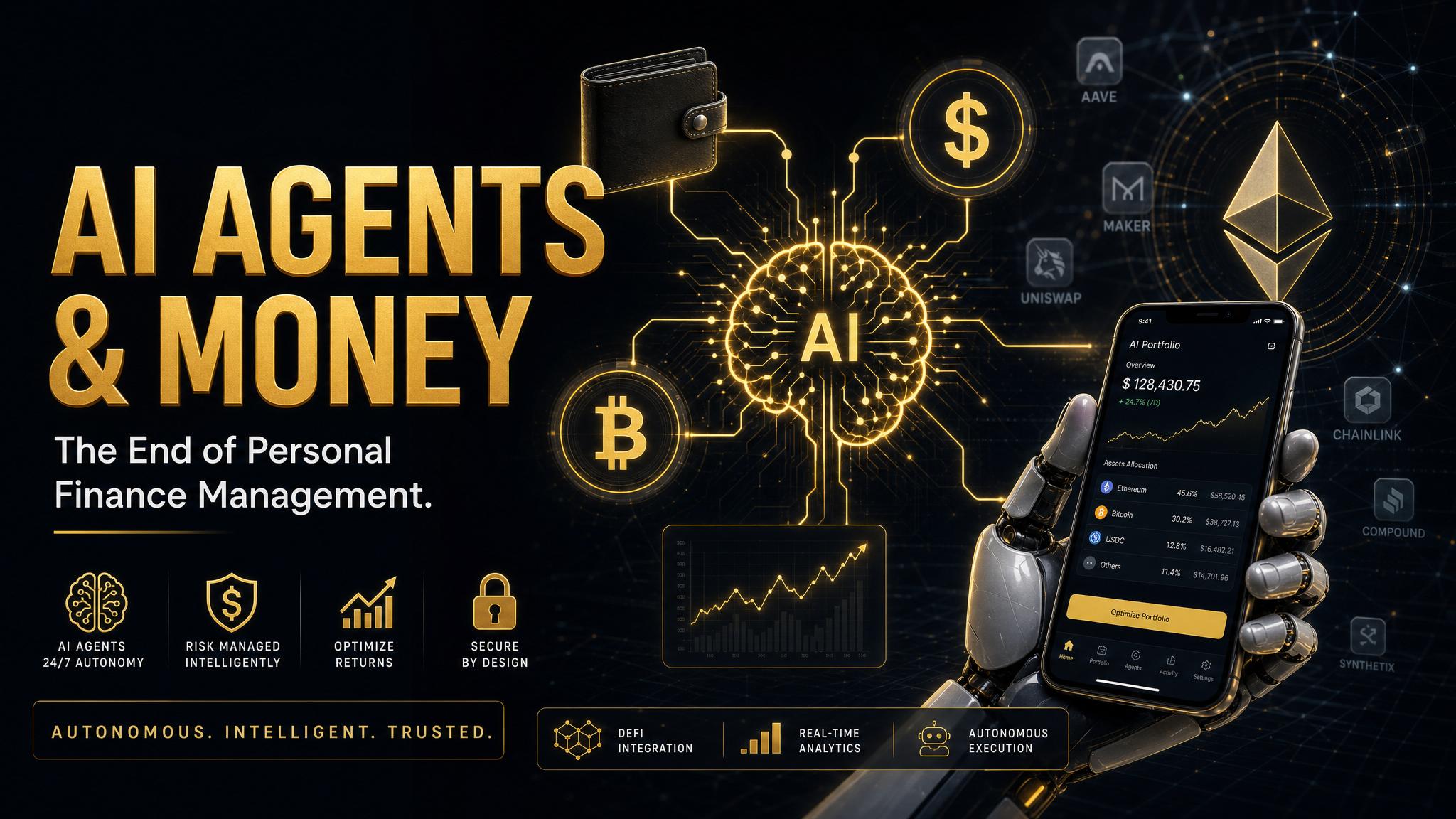

Imagine waking up one morning to find that your AI agent has already refinanced your mortgage at a 0.3% lower rate, rebalanced your investment portfolio in response to overnight market moves, paid all your bills at optimal times to maximize cash flow, and negotiated a lower APR on your credit card — all while you slept.
This isn't science fiction. The technical building blocks are already in place. What's coming in the next 3-5 years will fundamentally change what it means to "manage" your money.
The Three Convergences Making This Possible
Three technological forces are colliding simultaneously, and their intersection is where autonomous financial AI lives:
1. AI agents that can act, not just advise. The shift from AI as a chatbot to AI as an autonomous worker is already underway. Claude Opus 4.8, GPT-5, and their successors can now execute multi-step tasks, use tools, browse the web, and take actions — not just generate text. When these capabilities are connected to financial APIs, the agent doesn't just tell you to refinance. It does it.
2. Programmable money via stablecoins and smart contracts. As Jeremy Allaire, CEO of Circle (the company behind USDC), has argued extensively, stablecoins are creating "internet-native money" — dollars that can be programmed, transferred instantly, and accessed by anyone with an internet connection.
3. Open financial infrastructure via DeFi. Vitalik Buterin's original Ethereum vision — an open, permissionless financial system accessible to anyone — is becoming the rails on which AI agents will operate. A DeFi protocol doesn't ask for ID. It doesn't have business hours. It executes code.
What This Actually Looks Like: A Day in 2029
⚡ Scenario: Your AI Financial Agent — 2029
At 3:14 AM, your AI agent detects that the Federal Reserve just released unexpectedly dovish minutes. Within 400 milliseconds, it adjusts your bond/equity allocation, extends the duration on your savings yield strategy, and locks in a 30-year mortgage refinance at a rate 0.28% below what you were paying. Total cost: $0.003 in gas fees on Ethereum L2. By the time you wake up, your net worth has increased by an amount it would have taken a human financial advisor weeks to capture.
This scenario is not hypothetical fantasy. The individual components — agentic AI, DeFi yield protocols, L2 settlement, stablecoin rails — all exist today. The integration layer is what's being built right now.
The Currency Debasement Backdrop
To understand why this matters urgently, you need to understand the monetary context these agents will operate in.
Lynn Alden, one of the most rigorous macro analysts writing today, has documented in extensive research that the global fiat monetary system is structurally committed to debasement. Governments with large debt loads and aging populations have only one viable path: inflate their way out.
In this environment, a static savings account is a guaranteed loss in real terms. An AI agent that actively repositions your wealth across asset classes, currencies, and protocols 24/7 isn't a luxury — it becomes a necessity for anyone who wants to preserve purchasing power.
This is why Raoul Pal's "Exponential Age" thesis is so compelling. Pal argues we are at the intersection of the greatest technological acceleration in human history (AI) and the most significant monetary regime change since Bretton Woods (the decline of the dollar-denominated debt system).
"The intersection of AI and crypto is the most important investment thesis of our lifetimes. Both are exponential. Together, they are unstoppable."
— Raoul Pal, Real Vision CEO, @RaoulGMIThe Death of the Financial Advisor
This convergence has existential implications for a $135 billion industry: personal financial advisory.
Not because AI is "better" than human advisors in the way a calculator is better at arithmetic — but because AI agents operate in a fundamentally different time dimension. A human advisor reviews your portfolio quarterly. An AI agent monitors it every 400 milliseconds. A human advisor charges 1% AUM annually. An AI agent costs fractions of a cent per transaction.
The question isn't whether AI will replace financial advisors. The question is: what will financial advisors do after AI handles the execution layer?
The answer, most likely, is what doctors did after diagnostic AI arrived — move up the value chain to the decisions that require judgment, empathy, and contextual wisdom that machines still struggle with. The financial planner of 2030 won't manage your portfolio. They'll help you define what you actually want your money to do for your life.
What Michael Saylor Gets Right
In this context, Michael Saylor's relentless focus on Bitcoin as the hardest money ever created takes on new meaning. If AI agents are going to manage wealth autonomously, what should they hold as a store of value?
An AI agent managing a portfolio in a world of currency debasement would, logically, want to hold assets that preserve value over long time horizons. Bitcoin's fixed supply of 21 million coins, secured by the most powerful computing network in history, makes a compelling case as the "savings layer" that AI-managed wealth sits on top of.
The Unbanked Get a Banker
Perhaps the most profound implication of AI + DeFi isn't what it does for the wealthy — it's what it does for the 1.4 billion people globally who currently have no access to financial services.
Today, getting a bank account requires ID, a physical address, and proximity to financial infrastructure. DeFi requires none of these things. A farmer in rural Nigeria with a smartphone has the same access to Ethereum's lending protocols as a hedge fund manager in New York.
Add an AI agent that can navigate these protocols, optimize yields, and execute transactions on their behalf, and you've given that farmer access to financial services that rival anything available in the developed world — for a fraction of the cost.
This is what Vitalik Buterin meant when he described Ethereum as "a world computer." The financial operating system of the future is open-source, permissionless, and increasingly intelligent.
The Risks Nobody Is Talking About
The optimistic case is compelling. The risks are equally significant.
Who controls the agent? If your AI agent has access to your wallet and can execute transactions autonomously, who is responsible when it makes a mistake? When it gets hacked? When a bad actor manipulates the inputs it relies on?
Systemic correlation risk. If millions of AI agents are using similar models and similar strategies, they could amplify market crashes rather than dampen them. Flash crashes would become the norm, not the exception.
The regulatory gap. Regulators are decades behind. The legal framework for an AI agent that autonomously executes financial transactions doesn't exist yet. Until it does, this space operates in a gray zone that creates significant risk for early adopters.
The Bottom Line
The autonomous financial AI era is not a question of if — it's a question of when and how fast. The technical foundations exist. The monetary incentives (currency debasement, yield optimization in a world of structural inflation) are compelling. The infrastructure (DeFi, stablecoins, L2 networks) is being built.
What's left is the integration layer — the moment when an AI agent can hold a wallet, execute DeFi strategies, and manage a diversified portfolio without any human intervention beyond setting the initial parameters.
That moment is closer than most people think. The investors who understand this convergence earliest will be the ones who benefit most from it.
Follow @AITechWireIO for daily coverage of AI, finance, and the future of money.